
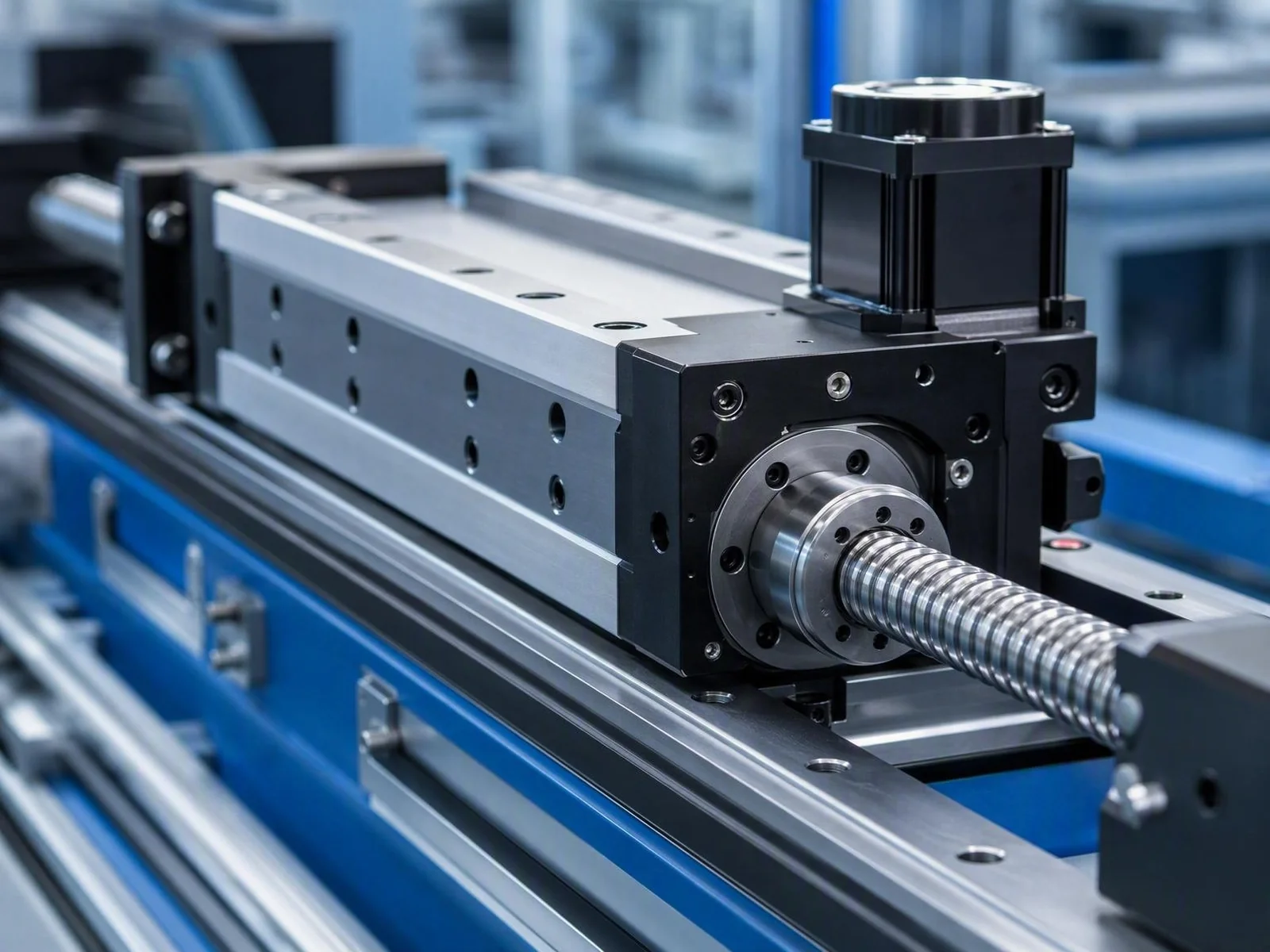
The Foundation of Every Precision Axis
Linear guides and ball screws sit underneath almost every accurate motion axis. A guide rail carries the load and constrains direction; a ball screw converts rotation into precise linear position. Their selection determines how accurately an axis moves, how long it lasts and how much maintenance it demands.
Accuracy Grade: Match the Requirement
Both guides and screws are supplied in defined accuracy grades, with tighter grades costing progressively more. The sensible approach is to specify the loosest grade that satisfies the application. Positioning error from the screw accumulates over travel, so longer axes typically need a higher grade to hold the same end-to-end accuracy. For very demanding applications, a linear scale providing direct position feedback can compensate for residual mechanical error — often more economical than moving to the tightest mechanical grade.
Preload and Stiffness
Preload removes internal clearance so that the assembly resists deflection under load in any direction. Light preload suits general positioning; medium preload supports machining and assembly forces where deflection affects quality; heavy preload is used for high-rigidity machine tool axes. Excess preload increases friction, heat and wear without improving results, so it should follow from a deflection requirement rather than being specified by default.
Load Capacity and Life
Guide life depends on the applied load and the duty cycle. Beyond the payload's weight, consider the moments created by an offset centre of gravity, which can load one rail far more heavily than a simple weight calculation suggests. Ball screws are also subject to buckling and critical speed limits on long, slender installations, which can make a larger diameter screw necessary even when load torque alone would allow a smaller one.
Lubrication and Protection
Lubrication separates the rolling elements from the raceway and is the single largest influence on service life. Grease suits most applications with moderate speeds and periodic maintenance; oil lubrication serves high-speed or continuously operating axes. Equally important is protection: wipers and seals on carriages, bellows or telescopic covers over exposed rail sections, and attention to how chips and coolant drain away. In contaminated environments, inadequate protection shortens life far more quickly than inadequate load rating.
Installation Determines Performance
Even a high-grade rail performs poorly if it is bolted to an uneven surface. Mounting faces must be flat and parallel within specification, and rails are commonly located against a machined shoulder to ensure straightness. Two rails must be aligned to each other and to the drive over the full stroke. Installation accuracy deserves the same attention as component selection, because misalignment converts a precision assembly into a binding one.
Care and Adjustment Over Time
Record the original running torque or positioning performance of each axis at commissioning. Periodic comparison reveals developing wear before it affects product quality, and preload adjustment or component replacement can then be scheduled into planned downtime rather than triggered by a failure.