
The Most Frustrating Fault Class
Intermittent electrical faults are the hardest problems in machine maintenance. A machine stops, restarts normally, and runs for days before failing again. The root cause is often a wire that was routed without sufficient bend radius, a terminal that was never properly crimped, or a connector that collects coolant. These failures originate in assembly, not in operation.
Design the Harness, Don't Improvise It
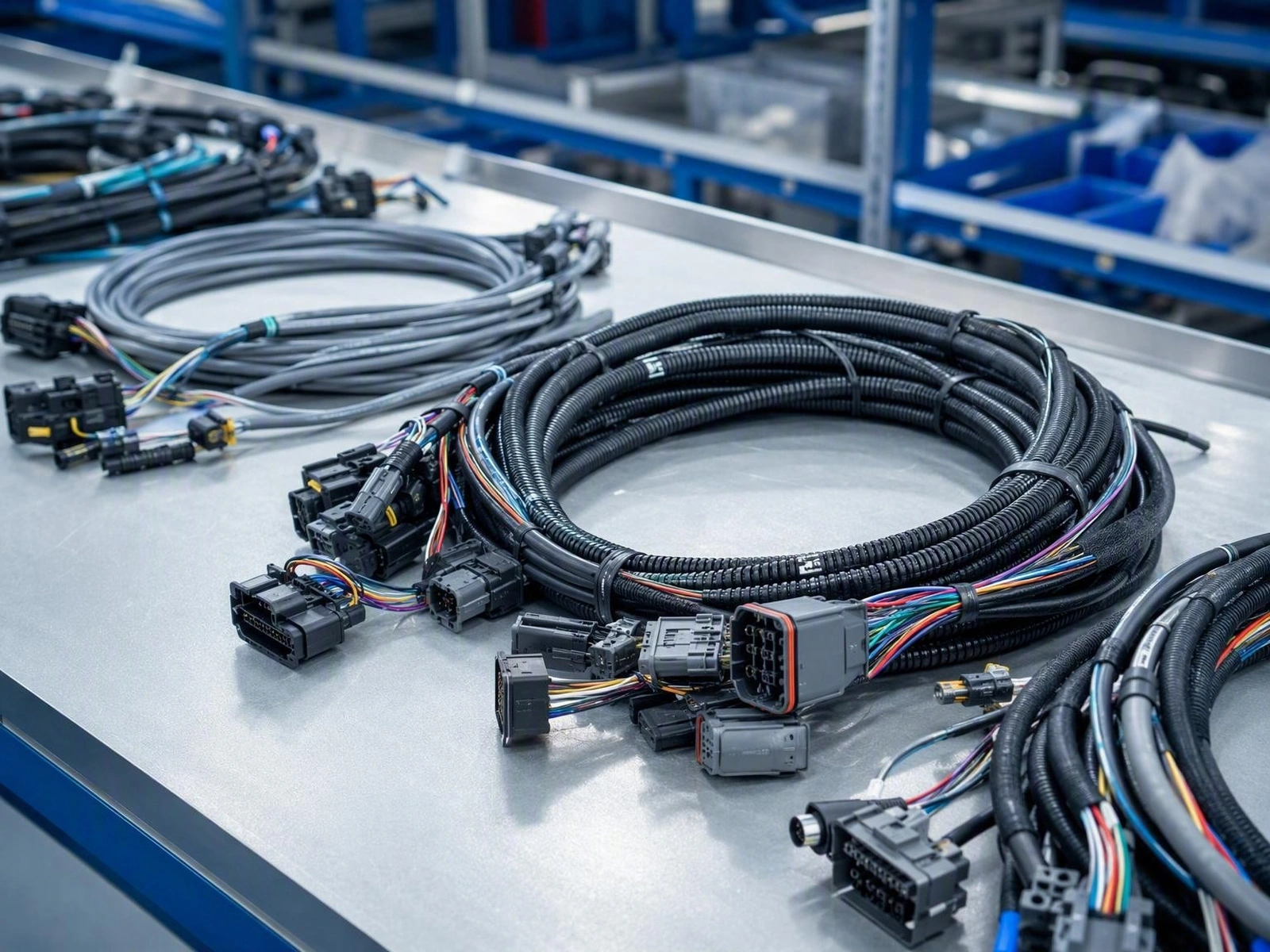
Wiring assembled on the machine, wire by wire, is difficult to replicate, inspect or repair. A harness designed as a drawing — with defined lengths, breakouts, branch points and connector assignments — can be built consistently, tested before installation, and duplicated exactly when a second machine is produced. That repeatability is what makes faults predictable rather than mysterious.
Crimp Quality Is Everything
Most connector failures trace back to the crimp. A correct crimp forms a gas-tight metallurgical bond between conductor and terminal, with the insulation support gripping the jacket separately to provide strain relief. Incorrect tool settings, mismatched terminal and wire sizes, or nicked strands from stripping all create joints that pass a quick continuity test and fail later under vibration. Using calibrated crimp tools with documented settings, and pulling a sample to destruction as a periodic check, is standard good practice.
Routing Rules That Prevent Damage
- Maintain the cable's minimum bend radius, especially at connectors and entries.
- Separate power and signal conductors to avoid electrical noise coupling into measurement and communication lines.
- Add strain relief wherever a cable enters a moving part or a panel gland.
- Protect against abrasion at every point where a bundle crosses a frame edge.
- Route away from heat sources and from areas exposed to coolant, chips or washdown.
- Move cables in the machine's moving axes with proper cable chain or flexible conduit, not free loops.
Labelling and Documentation
A wire number on both ends of every conductor, and a label on every cable and connector, converts a troubleshooting session from guesswork into a lookup. The machine's wiring diagram should be updated after every modification — an out-of-date drawing is worse than none, because it actively misleads the person repairing the machine.
Test Before and After Installation
Continuity and insulation resistance testing of a finished harness, performed on a test board before it is installed, catches assembly errors where they are cheapest to fix. After installation, verifying signal integrity and checking that all shields and grounds are properly terminated confirms the harness behaves as designed in the machine's electrical environment.
Built-In Diagnostics
Designing the control system to report which circuit has faulted shortens diagnosis dramatically. Where a machine's PLC can distinguish an open circuit from a short and identify the affected channel, maintenance staff move directly to the right panel rather than working through the whole system.