
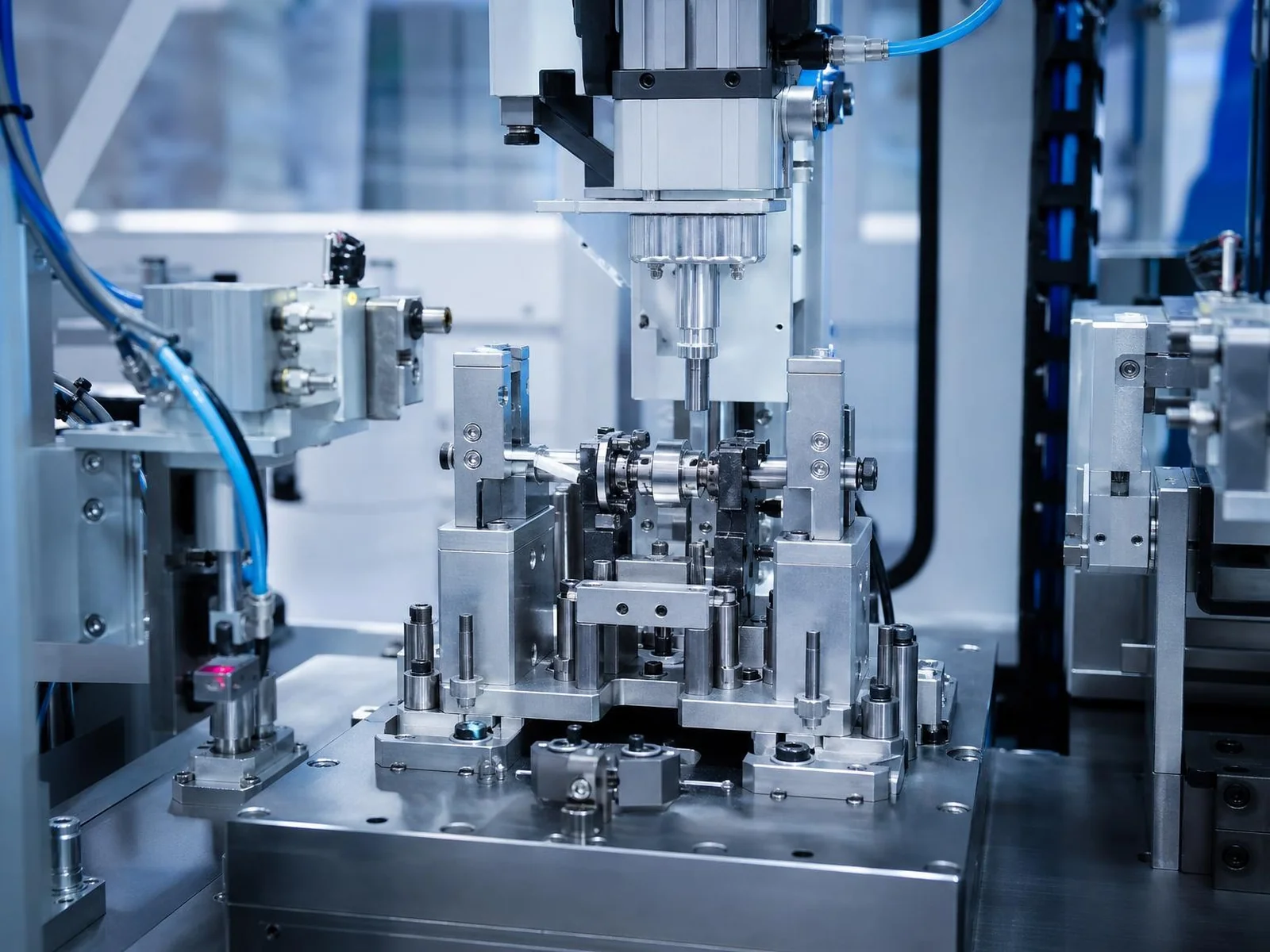
Why Fixtures Decide Part Quality
When a manufacturing process produces inconsistent results, the cause is often the fixture rather than the machine. A fixture's job is to position a workpiece identically every cycle, hold it rigidly against process forces and allow fast, unambiguous loading. Done well, it makes variation in the finished part small and predictable.
The Six Degrees of Freedom
Any free object in space can move in six ways: three translations and three rotations. A well-designed fixture constrains all six, no more and no fewer. Over-constraining — adding locators beyond what is needed — causes parts to rock or bind when slight dimensional variation exists, which is often worse than under-constraining. The three-two-one principle, using three locators on the primary plane, two on the secondary and one on the tertiary, is a reliable starting point.
Clamping Without Distortion
Clamps should hold the part against the locators, not bend it into position. Clamping force should be directed over a supported area rather than across an unsupported span, and applied close to the machining or assembly point where possible. For thin or flexible parts, consider vacuum or magnetic holding, or supporting the part beneath the work area rather than pressing it flat from above.
Error-Proofing the Loading
If a part can be loaded backwards, it eventually will be. Designing the fixture so incorrect orientation is physically impossible is more reliable than any instruction. Common approaches include asymmetric locator patterns, a clearance cut that only matches the correct orientation, and sensors that confirm part presence before the cycle is allowed to start.
Materials and Wear
Fixtures are working tools and they wear. Locating surfaces and clamp pads should be made from hardenable or hard-coated material, and replaceable wear plates or dowel-located inserts allow restoration without rebuilding the fixture. Aluminium bodies keep weight low for manual handling; steel or cast iron suits high-force applications where rigidity dominates.
Designing for Setup and Changeover
Where several part variants share a station, quick-change principles matter. Modular base plates, dowel-pin location, hand-tightened fasteners and permanently marked variant identification make changeover a matter of minutes rather than hours. Each variant's fixture should be stored with its own labelled place so it can be fitted correctly without reference to drawings.
Maintenance and Verification
Even a good fixture drifts. Include the fixture in planned maintenance: check locator wear, verify clamp force, and confirm the fixture still positions the part to specification using a master setting piece. Recording the original setup dimensions makes this verification quick and turns fixture maintenance from guesswork into a measurable routine.