Why Manual Inspection Has Limits
Human inspectors are skilled, but they fatigue. After several hours on a repetitive line, detection rates drift, judgement varies between operators, and small defects slip through. For products where a single flaw means a customer return or a field failure, that variability carries real cost.
What Machine Vision Actually Does
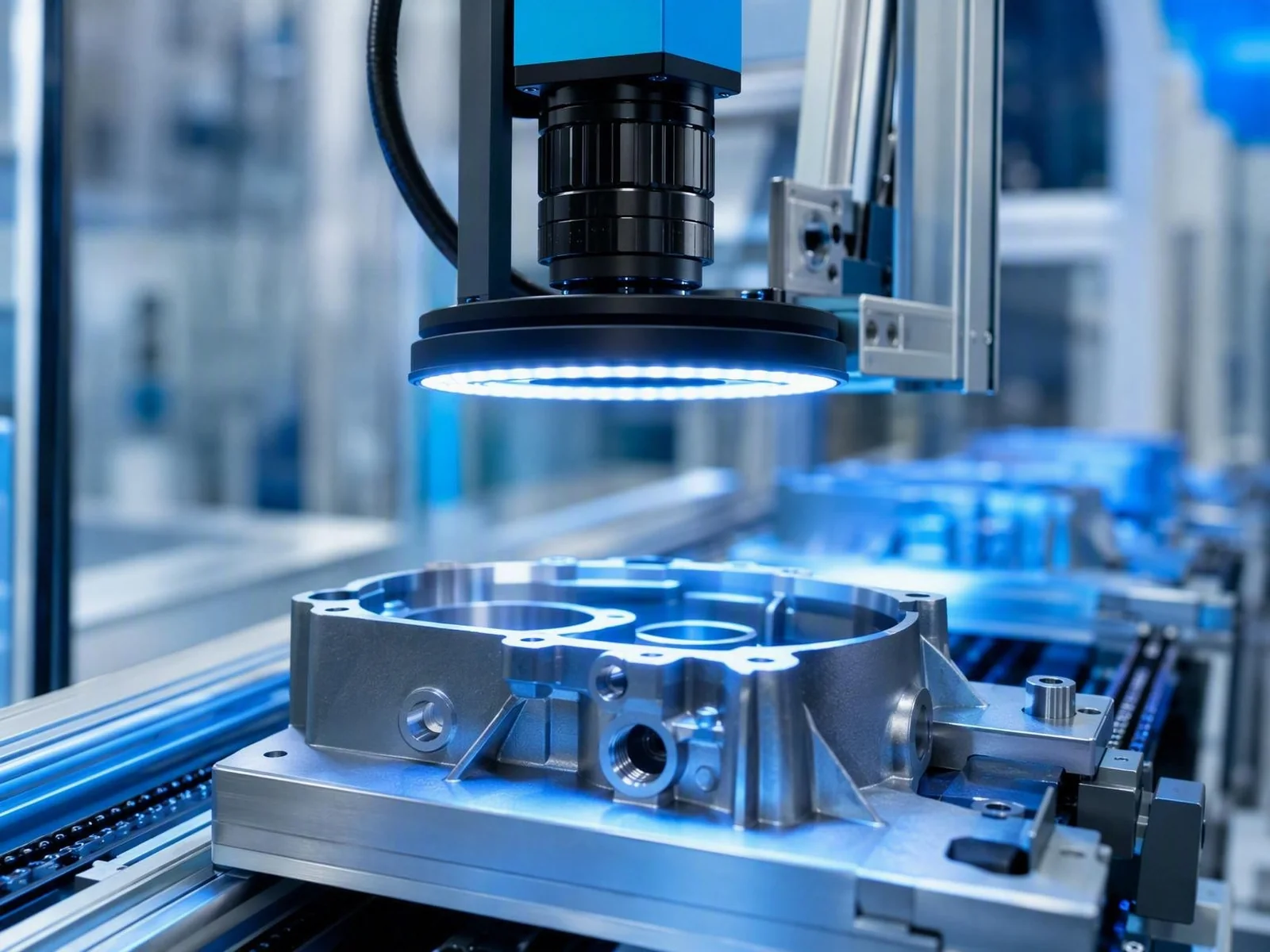
A machine vision system replaces the human eye with a camera, a lens, controlled lighting and software. The camera captures an image of each part; the software compares measurable features against a specification and returns a pass or fail decision in milliseconds. Typical measurements include dimension, hole position, surface finish, presence or absence of a feature, print legibility and colour consistency.
The Four Building Blocks
- Imaging — camera resolution and lens choice determine the smallest detectable defect.
- Lighting — the single most influential factor. Backlight, ring, dome or coaxial lighting each reveal a different class of defect.
- Optics and fixturing — a rigid mount and repeatable part position keep measurements comparable from cycle to cycle.
- Software and communication — pass/fail logic, statistics and an interface to the PLC that ejects rejects.
Where It Pays Back Fastest
Vision inspection delivers the quickest return where inspection labour is high, where defects are costly downstream, or where traceability is contractually required. High-volume stamped parts, electronic assemblies, connectors, machined components and printed labels are common starting points.
Getting the Specification Right
Define the defects you must catch and their minimum size before choosing hardware. A system specified around a real defect list costs far less than one bought for maximum resolution and then under-used. Sample parts — including good and bad examples — are the most useful input for any supplier.
Integrating with Automation
Vision rarely stands alone. It works best as one station in an automated flow: a handling mechanism presents the part, the camera inspects, the result drives a diverter, and data flows to a database for traceability. Designing the station together with the handling and control logic avoids the common problem of a capable camera starved by poor part presentation.