
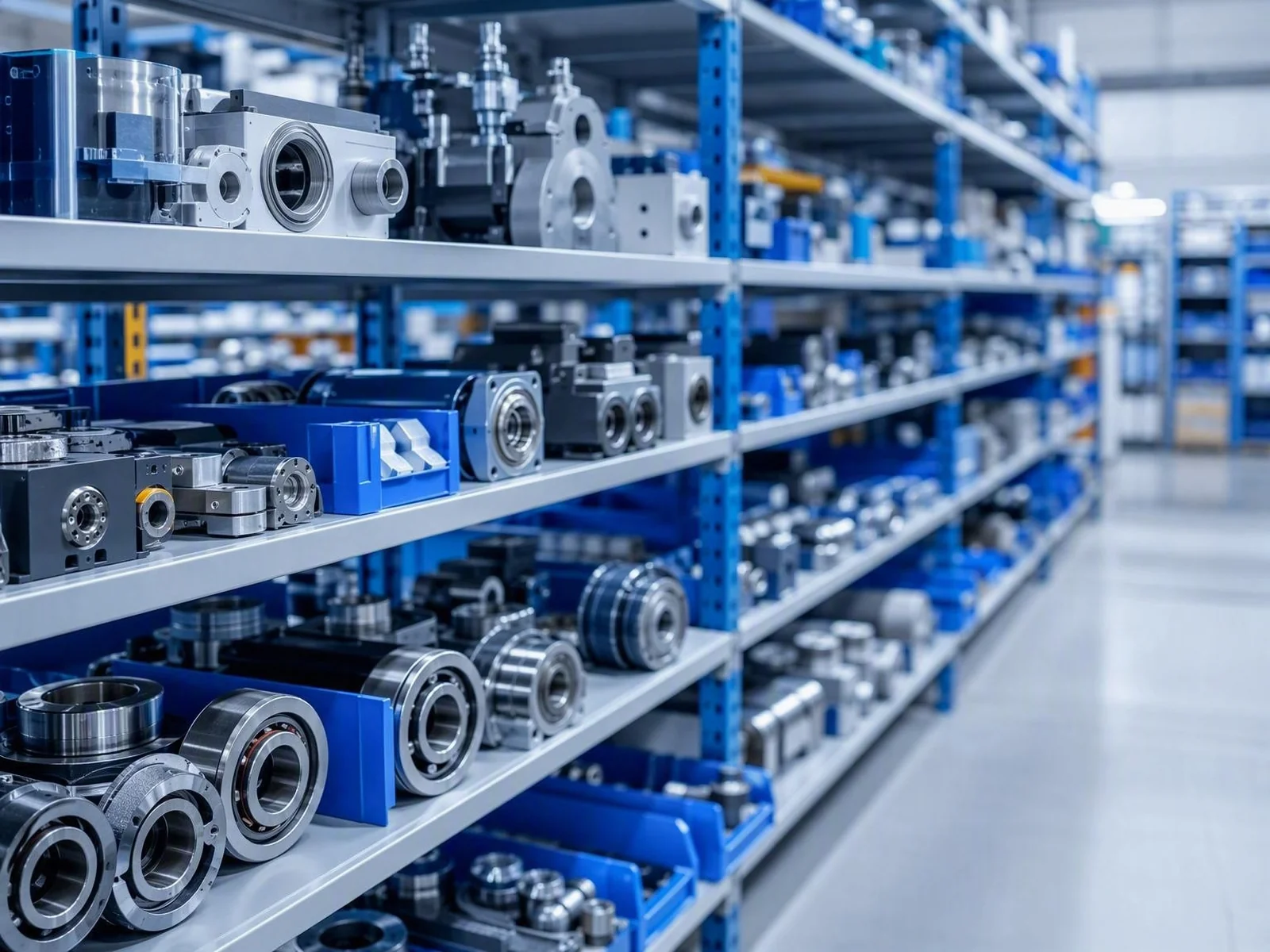
The Real Cost of a Missing Part
A bearing, sensor or drive module costing a modest amount can halt an entire production line. The financial impact of that stoppage — idle labour, missed delivery dates, expedited freight — usually dwarfs the part price by orders of magnitude. Spare parts strategy is therefore a production decision, not a purchasing detail.
Identify Critical Spares First
Not every component deserves a shelf slot. Begin with a failure-mode review of each machine: which parts stop production outright, which can be replaced from a neighbouring machine, and which have long lead times? Items that combine high impact with long lead time belong at the top of the list. Consumable tooling sits in a different category, managed by usage rate rather than failure risk.
Balance Holding Cost Against Risk
Inventory ties up capital and shelf space, and some components degrade in storage — rubber seals harden, batteries self-discharge, lubricants separate. A reasonable approach is to carry on-site stock only for the highest-impact items, arrange consignment or local stocking agreements for mid-tier parts, and rely on reliable suppliers with short lead times for the rest.
Standardise Where Possible
Standardising on a limited set of sensor families, drive sizes and fastener types reduces the number of distinct spares needed and simplifies training. Where a machine must use a proprietary module, record its part number, supplier and lead time in the machine documentation so a replacement can be ordered immediately.
Choose Suppliers on Total Value
Price is one factor among several. Evaluate suppliers on availability, technical support, response time, willingness to hold consignment stock and ability to supply equivalent or improved replacements when an original is obsolete. A supplier who can identify a compatible part quickly is often more valuable than one quoting the lowest unit price.
Documentation Is a Spare Part Too
Without accurate documentation, even a stocked part may not help. Maintain a bill of materials for each machine, updated after every modification, with photographs of assemblies and the location of each component. Combined with a simple inventory record showing minimum and reorder levels, this turns a parts cupboard into a functioning spares system.
Review the Strategy Periodically
Machines change, production priorities shift and suppliers come and go. Reviewing the critical spares list once a year — using actual failure history rather than assumptions — keeps the inventory aligned with where the real risk sits.